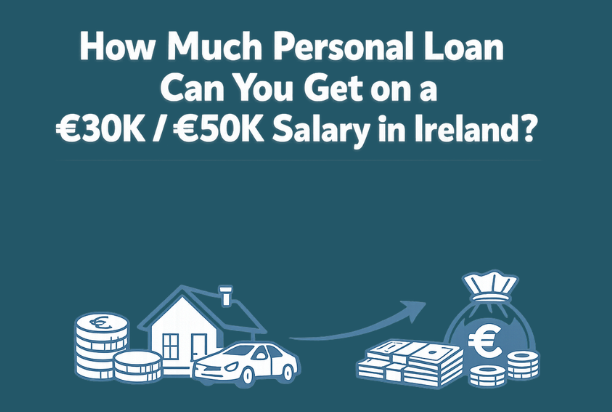
Different loan types require one to meet unique affordability requirements. Generally, you may get a loan of €2000-€75000 at a €30k-€50k salary. Loan providers analyse the amount that you should get according to your credit score, income, monthly bills, debt-to-income ratio, credit history and job stability.
Individuals with a high credit score may qualify for a higher loan amount. Similarly, individuals with bad credit history, low and inconsistent incomes may struggle to get the desired loan amount. In that case, one gets only what they can afford to repay comfortably.
What are the typical Personal loan limits in Ireland?
Most banks, credit unions, direct lenders, and AIB offer €2000-€75000 on a personal loan in Ireland. In which one can get €5000-€30000 for small purposes for the short term. Whereas the payout increases for large loans.
One may get €30000-€70,000 for bigger purchases or life-changing financial purposes like home renovation. However, getting a larger loan for a long term requires one to have a strong credit score, good income, and low existing debt.
How much can you borrow on a 30k/year salary in Ireland?
You may qualify for a loan amount of €8000-€20000. If you have no other significant debt in your name, you may get up to €25000. Again, the loan amount depends on your needs and affordability.
How much can you borrow on a 50k/year salary in Ireland?
You may get a loan of €15,000-€35,000 at a salary of €50,000. It depends on the risk assessment with the loan companies.
How do loan providers calculate how much you should get?
Here are some aspects that Irish loan providers consider before providing a loan:
a) Income Vs. monthly expenses
The loan provider analyses your monthly income and expenses to gauge your loan affordability. It discloses the amount that you can fairly afford to pay per month on a loan. Generally, monthly repayments should not cover over 30-40% of your net income. If it does, then you may struggle to get a loan at better rates.
b) Income multiplier
Generally, you get 10-20x of your monthly income as a loan. For example, if your monthly income is €15,000, you may get €3,00,000 as a loan (20x of 15000). However, only a few loan providers consider this method to provide a loan.
c) Job stability
Individuals with a decent and long credit history get instant approval for a loan. It reveals responsible credit behaviour and your potential to clear the dues. Therefore, you may qualify for better interest rates and terms. Consistent income eliminates the risk for the loan provider, and he may approve the loan application.
d) Residential status
You should prove your legal residential status with consistent and valid residential proof. You can provide it in the form of a council tax bill, utility bill, etc.
e) Frequency of monthly payments
Most loan companies analyse how regular you are with the loan payments. If you have set direct debits, it may work in your favour of you. However, if you only pay part-payments, then it may also affect the loan amount that you may get.
Can you improve your chances to get a higher amount?
Yes, you can improve your chances of getting a higher amount on the loan. You can do that by following the aspects like:
1) Try to increase repayment capacity
The better your repayment capability, the higher the loan amount you may qualify for. You can do that by consistently paying off the debt payments. Try to reduce the monthly expenses to accommodate a new loan. Next, analyse the possibilities to increase the income. The higher the income, the more loan amount you may get.
Identify how much you need and how much your income and expenses should be. Accordingly, you can plan the expenses. For example, if you can save just €200 per month, you can easily increase your loan amount limit by €7-€8k.
2) Optimise your credit profile before applying
Check and update the credit score before applying for the loan. It helps you fetch better interest rates and terms. You can do that by:
- Reporting the delinquencies
- Identifying and reporting the dual entries to the Central Registrar
- Part-pay on all the pending debts
- Try to consolidate some debts to reduce debt and streamline payments
- Pay priority debts like rent and energy bills first
- Keep below 30% usage of credit card of your available credit
- Do not make multiple loan applications within a short duration
The better the credit history, the higher the amount you may get.
3) Reveal stable income
Income is the most important aspect to get a loan. Individuals with part-time, self-employed income may also get a loan. However, the amount you get may be low in that case. It is because consistent income in the form of salaries eliminates the risk for the loan provider. Individuals with 6-12 months of consistent employment history may get the loan immediately and with a better amount.
Yes, a bonus may count as additional income. However, it should be a consistent part of your employment. If you receive a bonus once every year, then it could be part of your employment, and the loan provider may consider that.
4) Time your loan application correctly
Yes, the timing matters the most when you apply for a loan. Always analyse your recent financial actions. For example, if you took out a credit card lately, don’t apply for a loan immediately. Wait until you clear the loan payments. Here are other aspects to consider before applying for a loan:
- You can apply when you have cleared a heavy loan
- Your bank statements show a clear behaviour for 3-6 months
- You should not have any missed payments or overdraft credit usage
- Avoid applying right after making large expenses.
5) Add a co-applicant
If you need a higher amount, you can apply with someone having a good credit history and income. It also helps you split the responsibilities and repay the dues comfortably. Moreover, you may fetch a lower interest rate than what you could have got individually.
Bottom line
The amount you get on the loan depends on your credit score, income, finances and the amount you can save each month. Generally, you may get between €8000 and €20000 if you earn 30,000 Euros per year. Similarly, the loan payout reaches to €15,000-€35,000 at a salary of €50,000. It may help you achieve your personal goals without worries. But you can improve your chances to get a higher amount on the loan.