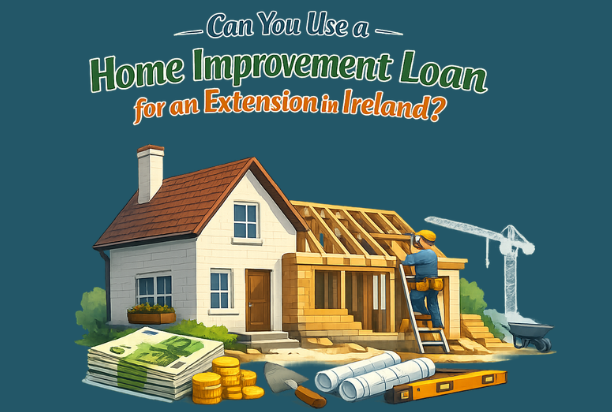
Yes, you can use a home improvement loan for an extension in Ireland. It is because extensions are generally permitted if it meets the local authority eligibility marks. A home improvement loan helps you split the cost and pay in small, fixed monthly instalments. It is especially true when you do not want to mortgage your property.
The amount you may want to borrow depends on your budget, credit profile, and whether you qualify with a bank, credit union, or lender. The blog discusses how you can use a home improvement loan for an extension in Ireland.
How Does a Home Improvement Loan for an Extension Work?
A home improvement loan usually works by borrowing a small amount and repaying it in fixed instalments according to the loan term. The exact process depends on the lender. Here are the basics of what you may expect while taking a house extension loan in Ireland:
Step 1- Analyse the loan amount and term
Check how much you need and for how long. Determine the amount of requirements by checking your monthly income and important expenses.
Step 2- Pre-qualify to determine loan costs
Once you know the best amounts, terms and the monthly amount you can repay comfortably, start pre-qualifying. Check the interest rates, total loan costs and other fees before choosing the right quote.
Also, check early payment options if you want to pay early and save money on interest charges. Pre-qualification does not hurt your credit score. It only helps you borrow correctly.
Step 3- Apply and provide documents
You may quickly get a basic quote stating the approximate loan terms. Check whether you can afford the amount. If yes, you may need to provide certain documents like- Bank statements, income proof, residential address proof and ID. Under a secured loan, you may need to provide details about the property acting as collateral.
Step 4- Get the loan
Once you provide the requested documents and you meet the eligibility and affordability criteria, you may get the loan. It generally takes 24-42 business hours to receive the funds in your bank account.
Step 5- Repay in instalments
You must repay the dues according to the loan agreement and the payment schedule. Missing payments may risk your property if acting as collateral.
How much can you borrow for a House Extension in Ireland?
According to facts, you can borrow up to €75000 (maximum) for a house extension in Ireland. It may vary according to the lender, credit union and respective government schemes.
However, the actual amount that you get also depends on factors like monthly income, monthly expenses, total monthly savings, type of loan, loan term and credit history. For example, you may borrow up to €15000 as a standard if your monthly liabilities do not exceed 35% of your total monthly income.
What Can a Home Improvement Loan Be Used for During an Extension?
You can use a home improvement loan for extension needs like structural build, license and permits, planning and designing costs, and adding fixtures and finishes. Here is what to expect:
| Aspects that you can borrow for | What to consider | How extension improve home value? |
| Structural build- roof, insulation, window and internal layout | Borrow only the amount needed. Keep some buffer | Improves usable floor space |
| Planning and designing (surveys, engineer fees) | Don’t forget to plan for professional charges | Proper design and compliance make the extension marketable |
| Fixtures and finishing (bathroom, kitchen) | Don’t compromise with the quality of fittings | Good and high-quality finishes attract interested buyers. |
What Are the Eligibility Requirements for an Extension Loan in Ireland?
You generally need to meet a basic criterion to get an extension loan in Ireland.
- Age and residency: You must be a permanent citizen of the Republic of Ireland, 18+
- Income and employment: Must have a regular income from full-time sources (preferable)
- Credit history: Must have a well-managed credit history with limited liabilities and high savings
- Property details: You must prove that you need to extend only your home. Provide the requested documents.
- Planning permission: An extension may require permits from the local authority. Get one before proceeding.
- Professional documents: You must provide the surveyor, insurance, compliance and details of the supervisor/architect/engineer who is enrolled on the project.
However, you must provide accurate documents in line with the requirements to get a home renovation loan in Ireland with the quickest turnaround. Understand the requirements carefully to avoid any mistakes.
How Much Does a House Extension Cost in Ireland?
The typical house extension in Ireland ranges from €2000-€2,500 per m2 for basic finish and €3,500-€5000 per m2 for luxury or high spec finish.
These figures include labour costs, materials, and VAT. However, this does not include planning commission and design costs. Also, the house extension cost in Ireland may vary according to:
- Region (For example, Dublin is the most expensive from an extension viewpoint)
- Access to the site
- Material quality
- Specialised features you need (underfloor heating or convertible wall)
Representative Example:
For example, if you are going for a 20m2 single-storey rear extension in Dublin, the expected cost of the project will be €55000-€75000. It includes VAT, professional fees, contingency and build cost. Similarly, a 40m² extension for a single storey may cost about €100,000 to €140,000.
Is a Home Improvement Loan Better Than Remortgaging for an Extension?
Remortgaging is generally better for larger extension projects like single-storey side and rear extensions. Alternatively, home improvement loans are generally better for smaller and quicker projects like kitchen extension, bathroom extension or living room extension projects.
Remortgaging may prove cheaper over time. However, a home improvement loan helps you get quick results and does not involve much complexity.
| Aspects | Home improvement | Remortgage |
| Loan amounts | €50,000-€75,000 | From €15,000 up to 90% of the house’s equity |
| Approval speed | You may get approval within 24 hours. | The process is slow as the mortgage provider reassesses the mortgage, property, value and affordability. |
| Interest rates | Typically, higher interest rates | Lower for a larger borrowing amount, as it is secured on the property |
| Repayment terms | Shorter repayment term, 12 months-5 years | Longer repayment terms of 10-15 years |
| Security requirement | These are often unsecured, but can be secured | Secured against the property |
| Flexibility | Ideal for smaller projects | Less flexible due to tough mortgage conditions |
Can You Get a Home Improvement Loan for an Extension with Bad Credit?
Yes, you may get a home improvement loan for an extension with a bad credit score. However, the loan approval depends on your ability to repay the dues without missing any. You may get a loan if you can prove consistent income, low monthly debts, and that the extension adds value to your home.
Here are some tips that might help you improve the chances of getting a home improvement loan despite a bad credit history:
a) Reduce existing debts
Try to clear off the existing debt log as much as you can. You can begin by making small payments that you can comfortably make with your savings.
b) Be regular with bill payments
Set direct debits for all the important bills like rent, credit cards, council tax, etc. Be regular with monthly payments and build a positive credit history.
c) Save for a deposit
Yes, sometimes you may need to provide a loan deposit to get a higher amount on the loan. Start saving for that and get better terms
d) Apply for a realistic amount
Understand your affordability and apply for only the amount that you can afford to repay. Consider the project costs in detail and determine the amount consciously.
What Are the Alternatives to a Home Improvement Loan for an Extension?
Here are some alternatives to a home improvement loan that you can check:
You may use a personal loan for any structural changes or home extensions. You may get €25000-€50000, depending on the unsecured and secured loans that you tap.
The monthly repayments stay fixed on these terms. It means you can budget and set direct debits to pay effortlessly. You can repay the dues within 5-10 years, depending on the loan type and your repayment comfort.
Bad credit loans are for individuals who struggle to get a home improvement loan due to pending payments, low credit history or defaults. You may get up to €10000 for your small extension needs, like getting permits from the local authority.
The credit search would not affect the history. Individuals with consistent income, citizenship proof, a stable address and a valid bank account may qualify. Thus, you may consider a bad credit loan to finance a home extension in Ireland if you need affordable quotes.
You may consider a debt consolidation loan if you need money urgently to support renovation needs. It helps you merge different debts into a single payment system.
Later, you repay only one creditor instead of many. The loan helps you save on interest and total payments. It means you can use the savings for urgent home extension needs.
What Mistakes Should You Avoid When Financing a House Extension?
Here are some common mistakes to avoid while financing a house extension:
1. Starting with assumptions
You must have a plan before going for an extension project. Include aspects like:
- Why do you want to extend the place?
- How much do you want to extend it?
- What permits would it require?
- Do you need a surveyor, and how would you pay for professional fees?
Analyse details like these before proceeding with the project.
2. Not getting permits
Most people assume that permits would not be needed. As a result, they must let go of the extension that they had constructed recently. Check with your local authority and designer before committing to a layout.
3. Forgetting about the less obvious parts
People may budget for the new living room, the interiors, etc. However, they often forget about small stuff like electrical upgrades, insulation, flooring, painting and joinery. You must understand the complete job before taking on the project.
Conclusion
Yes, you can use a home improvement loan for an extension in Ireland. However, determine the amount of requirements, permits, licenses, and deposit requirements. Check whether the loan is the most inexpensive way to do so.
If not, explore the alternative options like personal or bad credit loans. You may lose your home on a home improvement loan if you don’t pay the dues. Therefore, understand your liabilities before committing to a long-term goal.
FAQs
Can I use a personal loan for a house extension in Ireland?
Yes, you can use a personal loan for a house extension in Ireland. However, personal loans are generally ideal if you want to borrow only a small amount for your project.
Do I need planning permission before applying for a loan?
Whether or not you will need planning permission depends on your local authority standards, home extension requirements and project scale. However, you generally need planning permission proof to get approval for a home extension loan.
Can I use the loan to pay builders?
Yes, you can use the loan to pay off the builders involved in the respective home extension project. Always check the invoices before clearing the dues.
Is a home improvement loan secured or unsecured?
A home improvement loan can be secured or unsecured depending on your loan amount needs, credit history and repayment term within which you want to pay the dues.

Erin Delaney is a financial writer and content strategist with strong hold on personal finance and lending related topics. She is well aware of the fact that talking about money or loans can be stressful for borrowers. To help them make informed financial decisions, she has dedicated her 10 years of her career in making complex topics like loans, bad credit, etc., easy to understand for them.
Her speciality is to write clear, informative and reader-friendly content. She keeps herself updated with the latest trends happening in the lending industry to deliver information that is useful for the borrowers.